
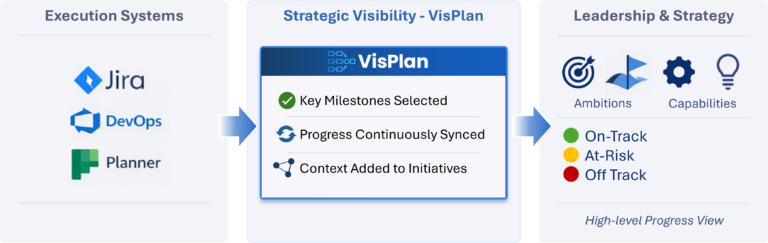
Jira is great at capturing delivery. Thousands of issues, epics, and stories describe what teams are working on every day.
For leaders, the question is simpler: which of these actually matter for our strategy, and how are they progressing? That’s the problem the new Jira integration in VisPlan is designed to solve.
Why “import everything” fails
Most integrations aim to pull everything across. In practice, this creates noise.
Entire Jira hierarchies flood strategic views, turning them into operational replicas and forcing teams to maintain the same information twice. Strategy doesn’t need more data. It needs focus.
Select what matters
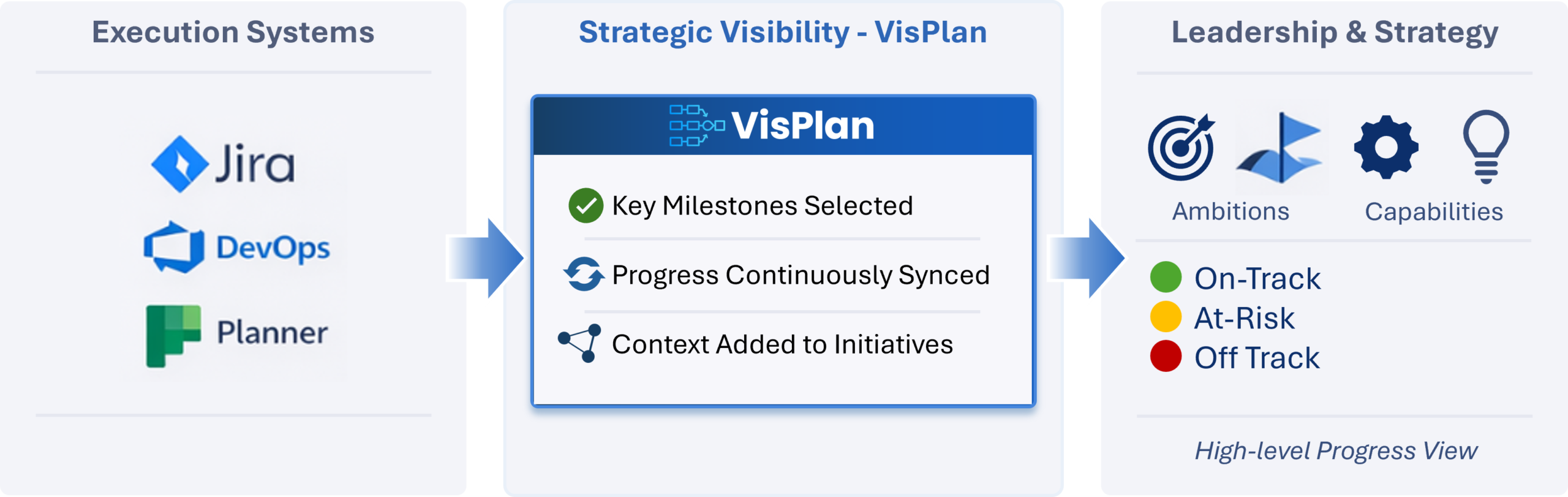
With VisPlan’s Jira integration, connection starts with intent. You securely connect via OAuth 2.0 and choose only the Jira issues that represent meaningful deliverables. These high-level items become Actions in VisPlan, tracked in the context of ambitions and objectives. Jira remains the system for detailed execution. VisPlan shows what matters at a strategic level.
Faster alignment, less effort
You can now multi-select Jira issues and link them to existing Actions or create several Actions at once. Whole workstreams or releases can be aligned to strategy in seconds. The integration requires a one-time configuration by an IT administrator, with no code and no setup needed from end users. The same experience applies when working with Azure DevOps.
Always in sync
Once connected, Jira and VisPlan stay aligned. Names, descriptions, dates, assignees, and progress sync in both directions. Teams work as usual in Jira, while leaders see progress against strategy. Detailed work item breakdowns stay in Jira. VisPlan surfaces only the key deliverables that signal progress. This keeps leadership conversations centred on outcomes, dependencies, and delivery status. The result is a direct link between strategy and execution, without overload.